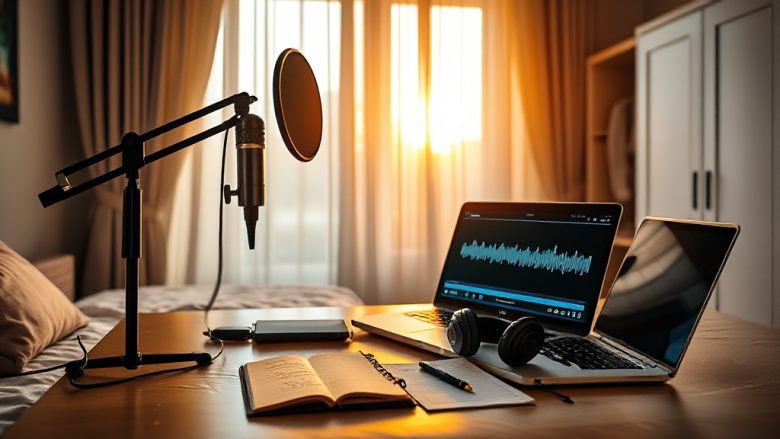
Search for podcasting advice and you will drown in gear lists. Microphones that cost more than a used car, acoustic panels, mixers, boom arms, interfaces, headphones with a frequency response chart longer than your arm. It is enough to make anyone close the tab and never hit record. Here is the truth: almost none of that matters at the start. This beginner guide to podcasting is built around the only three things that matter when you have a topic and a laptop: a clean audio signal, a quiet room, and the discipline to publish. Everything else is a later problem.
You can go from zero to a published first episode inside a month. Not a perfect episode. A published one. That distinction is the whole game.
What gear do you actually need to start a podcast?
Less than you think. A single USB microphone with a built-in headphone jack is the honest minimum. Something in the entry tier from a brand you have heard of will do the job for episode one and episode fifty. You do not need an audio interface, a mixing desk, or a condenser microphone that picks up your neighbour’s dog.
Buy three things: the microphone, a pair of closed-back headphones so you hear what the recording actually sounds like, and a pop filter or foam windscreen. That is it. Total spend, if you shop carefully, is roughly the price of a decent pair of trainers. If money is tight, start with the microphone and borrow headphones. If money is genuinely tight, record your first episode on your phone’s built-in mic, listen back, and decide whether you enjoy the process before spending anything at all.
What you should not buy yet: a mixer, a boom arm, a shock mount, acoustic foam, or a second microphone for guests. Every one of those is a solution to a problem you do not have until you have recorded a few episodes and know what is actually bothering you.
Setting up a recording space that sounds good enough
Sound quality is mostly room quality. A cheap microphone in a soft room beats an expensive microphone in a bare one. Your job is to stop your voice bouncing off hard surfaces before it reaches the mic.
Pick the smallest room you can stand to sit in. A bedroom with a bed, curtains and a wardrobe is close to ideal. A kitchen or a hallway with hard floors is the worst possible choice, and no amount of post-production fixes it. Sit with your back to something soft, face into the room, and put the microphone about a hand’s width from your mouth, slightly off to one side so you are not breathing directly into it.
Now kill the noise. Close the window. Turn off the fridge if it hums through the wall. Put your phone on airplane mode, not silent, because a vibration on a desk is audible. If you have a laptop with a fan that spins up under load, close the heavy apps. Record a thirty-second test, listen back on headphones, and you will hear exactly what your listeners would have heard. Fix the loudest problem, test again, move on. Two rounds of this is usually enough.
One more thing: record at the same time of day each session. Traffic, neighbours and household noise follow patterns. Finding your quiet window once and sticking to it saves you more editing time than any plugin.
Recording your first episode without freezing up
The microphone is intimidating for about ninety seconds. Then it is just a tool. Before you record anything real, hit record and talk for two minutes about what you had for breakfast. Listen back. You will hate your voice. Everyone does. Push through it, because the discomfort fades after three or four sessions and never comes back.
For your actual episode, write a loose outline rather than a script. A script read aloud sounds like a script read aloud. Bullet points with a few key phrases keep you on track while letting you sound like a person. Open with a short, clear statement of what the episode covers and why someone should care. Then talk. If you stumble, pause for three seconds and start the sentence again. That pause is an easy edit point later, and it is far less painful than trying to fix a fluffed line in post.
Do not stop the recording to fix small mistakes. Keep rolling. A forty-minute raw take with ten mistakes is easier to work with than ten separate takes. Record a little room tone at the end, thirty seconds of silence with nobody talking, because you will want it later for smoothing edits.
Editing basics: how much polish does episode one need?
Far less than you fear. Your goal is not broadcast polish. Your goal is that a listener on a commute does not have to reach for the volume dial. That means four moves, and no more, for your first episode.
First, cut the dead air and the false starts. Second, remove any loud clicks, coughs or chair squeaks. Third, apply a light noise reduction if your room has a constant hum. Fourth, normalise the volume so the whole episode sits at a consistent level. If your editing software has a one-click voice cleanup preset, use it and stop fiddling.
Resist the urge to add music beds, sound effects and elaborate intros. A simple spoken intro and outro, recorded once and reused every episode, is plenty. If you spend six hours editing episode one, you will not make episode two. Aim for a ratio of roughly one hour of editing per one hour of recording at the start, and let that shrink as you get faster.
Hosting and publishing: getting your episode out into the world
Hosting is where beginners get stuck, because the terminology is confusing. Here is the plain version. A podcast host is a service that stores your audio file and produces a feed that podcast apps can read. You upload an episode, the host gives you a feed, and you submit that feed once to the major directories. After that, new episodes appear automatically in every app that follows the feed. You do not upload to each app individually, ever again.
Choose a host on three criteria: a straightforward upload process, clear analytics showing downloads per episode, and a price you are happy paying monthly. Ignore anything else for now. Most reputable hosts offer a free or low-cost starter tier that is more than enough for a first season.
Before you publish, prepare three small assets. Cover art, which is a square image with your podcast title readable as a thumbnail. A show title and a one-sentence description. And episode titles that say what the episode is about rather than being clever. That is the entire publishing checklist. It takes an afternoon, and then it is done forever.
Your first-month schedule for launching a podcast
The month matters more than the gear. Here is a realistic sequence that gets you to three published episodes without burning out.
Week one: decide your topic, your format and your show name. Record a two-minute test on whatever you already own. Buy the microphone and headphones only if the test convinces you to continue. Week two: set up your recording space, record episode one, and edit it. Do not publish yet. Week three: set up your hosting account, prepare your cover art and show description, and publish episode one. Record episode two in the same week so you stay ahead. Week four: publish episode two, record and edit episode three, and publish it. By the end of the month you have a show with three episodes, which is the point at which strangers start taking it seriously.
The single biggest predictor of whether a new podcast survives is whether the host records episode two within a week of publishing episode one. Momentum is fragile. Protect it.
You will make mistakes. The first episode will have an awkward pause you missed, the second will have a level dip, the third will be noticeably better than both. That progression is the reward, and the only way to reach it is to stop reading gear lists and start recording.
Frequently asked questions about starting a podcast
How long should my first episode be?
Between fifteen and thirty minutes. Long enough to cover something useful, short enough that you can edit it in one sitting and your listener can finish it on a commute. You can grow longer once you have a rhythm.
Do I need a co-host to start?
No. A solo show is simpler to schedule, simpler to record and simpler to edit. If you want a co-host, find one after you have published a few solo episodes and know what the workflow actually involves.
How do people find my podcast?
Mostly through you talking about it. Mention it in the places you already spend time, keep publishing consistently, and let the back catalogue build. Discovery is slow at first and that is normal, not a sign of failure.
What if I hate the sound of my own voice?
You will, for about three episodes. Then it becomes just a sound. Do not let it stop you publishing, because the only cure is repetition.